A recent story from the boiler house:
It was a normal night shift until it wasn’t.
One of the boilers shut down for no apparent reason. No warning, no obvious alarm, no trends—the control screen just went blank and the burner dropped out. It’s just the kind of thing you were hoping to avoid on your night shift. Yet. You always know, there’s a chance.
The night-shift operator did exactly what a good operator does: he tried to bring it back. He worked through the reset, checked what he could test, and when the boiler refused to come back to life, he made a smart call. He got another boiler online (in a hurry) to keep the plant running and left the stubborn one to sit until he had help.
Day shift arrived and picked up the puzzle. They power-cycled the controls. They went hunting for loose wires, a bad connection, anything that would explain a dead screen and a boiler that wouldn’t fire. They tried multiple things. Nothing worked.
So they did what you do when you’ve exhausted your own ideas—they called a technician. As luck would have it, the tech was around the corner and said he’d stop by.
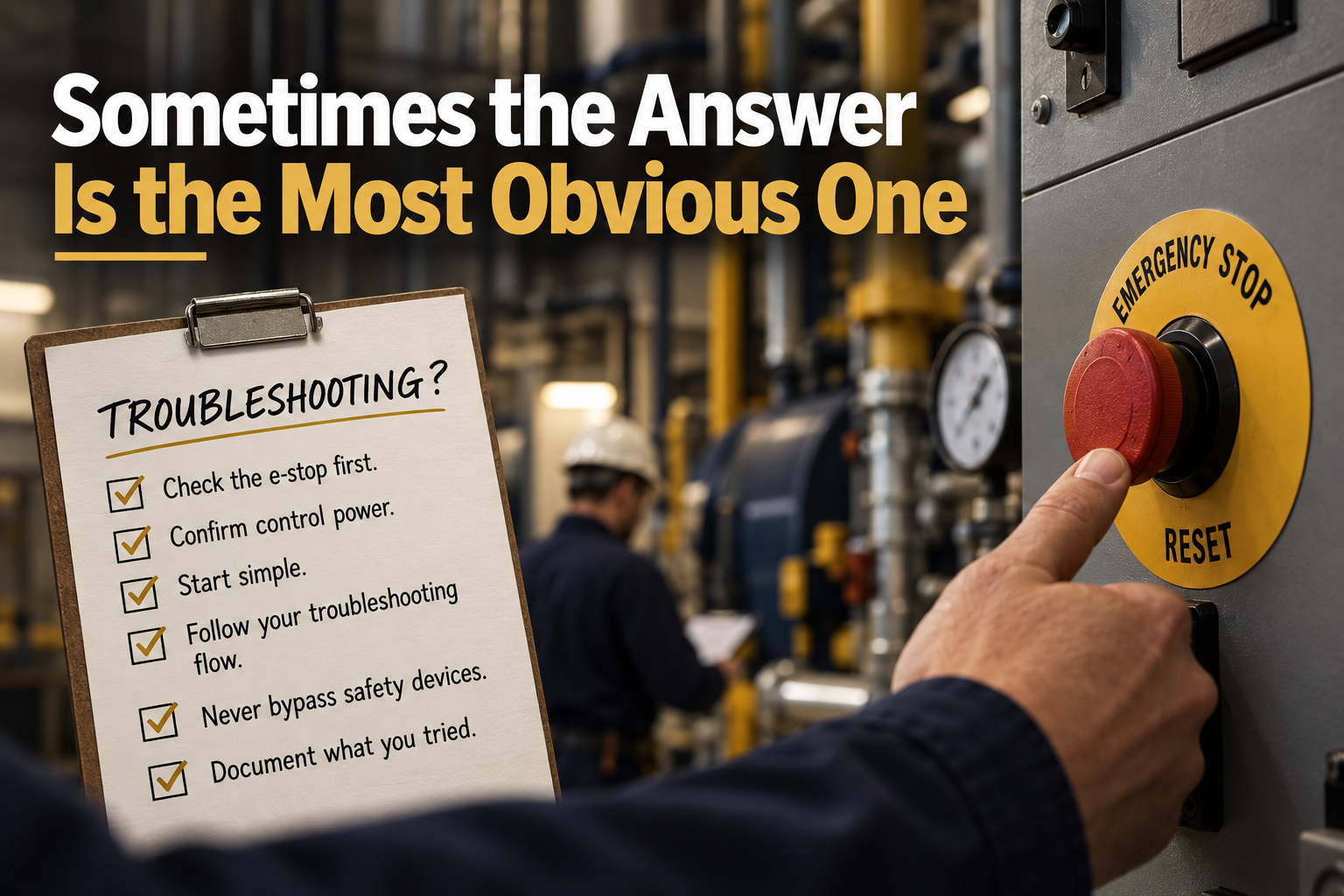
He pulled in, got briefed and started his process. About 20 minutes later the tech walked into the control room. He reached up to the main panel that serves all four boilers and reset the emergency stop button on the boiler that had tripped overnight.
That was it. That was the problem.
One push of a button—the very button designed to be found and pressed—and the boiler was ready to run again.
Why We Miss It
The e-stop is easy to overlook because we stop seeing it. It sits on every panel, it’s always there, and we walk past it a hundred times a shift. But that button is a hard trip, and it’s meant to be. When it’s engaged, it cuts the boiler out and holds it out until someone physically resets it—by design. That’s what makes it dependable in a real emergency, and it’s exactly why it deserves a look before you start pulling wire.
A blank screen and a dead burner can look like a dozen different failures. In a world where the “automated”, automatically tells us the issue, we find that in the real world this isn’t true. We still have to test our knowledge. It’s human nature to chase the complicated answer first, especially when the simple one seems “too easy.” But troubleshooting works best when we start at the simplest, most likely cause and work outward—not the other way around.
Before You Call the Tech
Check the e-stop first—every panel, every boiler. Reset it and see what happens.
Confirm control power and complete a proper reset before chasing connections or wiring.
Slow down and start simple. Recent work, recent trips, and the obvious switches come first.
Never bypass or defeat an e-stop to force a boiler back on. If it tripped, find out why.
Hand off clear notes—what happened, what you tried, what changed. The next shift shouldn’t start over.
You should absolutely have a list of troubleshooting flows for each major piece of equipment. This will limit unnecessary calls to the tech. As we learn more these flows will continue to grow with us, making us more and more self-sufficient in the boiler room.
Here’s the takeaway. Not every shutdown needs a technician, and not every solution is complicated. Sometimes the answer is the most obvious one—sitting right there on the panel, waiting to be reset. The best troubleshooters aren’t the ones who know the most exotic failure mode. They’re the ones who remember to check the simple things first.